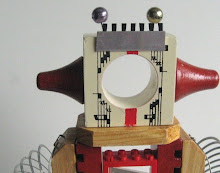
So, I have been tumbling around the arts for a very long time.
I am also a crafter and an explorer. I am elaborating my jewelry designs and I have started to add some of them.
What to know a little more about Tumbleweedstudio you can visit her blog
If you create the right environment in your backyard, you can provide a safe haven for birds. The birds, instead of living somewhere harmful to humans and themselves, will be able to safely nest in your backyard.
Here are a few tips to lure them there.
No Pesticides
First of all, do not use pesticides. The pesticides may kill the birds you are trying to attract.
Proper Trees
If you've landscaped your home for energy savings, you probably have a few trees in your yards. The evergreen trees make a great year-round home for birds, especially those that have berries and seed-producing cones. You'll also want to grow deciduous trees that have berries, fruits or other possible bird eats.
Reduce the Size of Your Lawn
A big lawn does not make a bird-magnet. A large lawn can also consume a lot of time, money, water and lawn-mower gasoline. Planting shrubs or hedges or anything that provides cover for birds is preferable. Bird houses also work as cover.
Water
Birds need water. Any shallow pool of water can provide birds water. A bird bath is a popular method of providing off-ground water to birds. Birds are vulnerable to cat and other predator attacks when they are on the ground. To keep the cats off your bird bath grow prickly plants along its base.
Bird Feeders
Birds are attracted to feeders. Feed them native seeds if possible. Exotic foods can give native birds digestion troubles. You can make your own using recycled plastic bottles. I did mine (see picture above)

I’m going to repost this article in honor to our Mother Earth Week
Robert Roy Britt
Senior Science Writer
SPACE.com Tue Jul 1, 12:33 AM ET
Earth emits an ear-piercing series of chirps and whistles that could be heard by any aliens who might be listening, astronomers have discovered.
|
|
Scientists have known about the radiation since the 1970s. It is created high above the planet, where charged particles from the solar wind collide with Earth's magnetic field. It is related to the phenomenon that generates the colorful aurora, or Northern Lights.
The radio waves are blocked by the ionosphere, a charged layer atop our atmosphere, so they do not reach Earth. That's good, because the out-of-this-world radio waves are 10,000 times stronger than even the strongest military signal, the researchers said, and they would overwhelm all radio stations on the planet.
Theorists had long figured the radio waves, which were not well studied, oozed into space in an ever-widening cone, like light from a torch.
But new data from the European Space Agency's Cluster mission, a group of four high-flying satellites, reveals the bursts of radio waves head off to the cosmos in beam-like fashion, instead.
This means they're more detectable to anyone who might be listening.
The Auroral Kilometric Radiation (AKR), as it is called, is beamed out in a narrow plane, as if someone had put a mask over a torch and left a slit for the radiation to escape.
This flat beam could be detected by aliens who've figured this process out, the researchers say. The knowledge could also be used by Earth's astronomers to detect planets around other stars, if they can build a new radio telescope big enough for the search. They could also learn more about Jupiter and Saturn by studying AKR, which should emit from the auroral activity on those worlds, too.
The AKR bursts -- Mutel and colleagues studied 12,000 of them -- originate in spots the size of a large city a few thousand miles above Earth and above the region where the Northern Lights form.
"We can now determine exactly where the emission is coming from," Mutel said.
Our planet is also known to hum, a mysterious low-frequency sound thought to be caused by the churning ocean or the roiling atmosphere.
#1 - Make some money
:The most satisfying, green way to get rid of stuff is to make some green.
:High-end clothes can go to consignment.
:Collectibles do well on ebay.
:Toys, children’s clothing, and knick knacks are yard sale best sellers.
:For large numbers of antiques or vintage china, silver, or porcelain, try an auction warehouse or etsy.
#2 - Have a place in your home
Designate the corner of a closet or your laundry room for housing discards to donate. Try to do this every other month. Keep a hamper or garbage can in your designated spot and whenever you see an item cluttering your home that you or your family members 1) don't use, 2) don't love, or 3) have outgrown, put it in the hamper. At the end of each month, bag the items and take them to a donation center, or call to have them picked up. The Veterans and Big Brother Big Sister will pick up clothing and small household items at your home.
#3 - Have a swap party
My friends and I have a seasonal purge party. We all bring items we no longer need or use: clothes, jewelry, purses, home décor, small furniture, magazines, etc. It goes into a pile in the middle of the room and we all dive in! It is a fun way of getting rid of things, getting a few new things, and catching up with friends. At the end of it, we bag all the items we don’t want and donate them to a women’s shelter. This also works well with a group of moms and the clothing and toys your children have outgrown.
#4 - Re-use your own stuff
Reusing common house hold items for new organizational ways can really save you money. Try thinking outside the box as to the way you use common items. For example, empty gift baskets make great mail bins, in-boxes, planters, magazine bins, small toy organizers and more. Walk around your house and really look at your stuff. Can any of it be used for a different purpose? A bookshelf hung on the wall instead of on the floor, a TV cabinet for a night-stand, a shoebox to divide different kinds of socks in a drawer? Try to think creatively and objectively. Wanna check some great upcycled items and green tips?